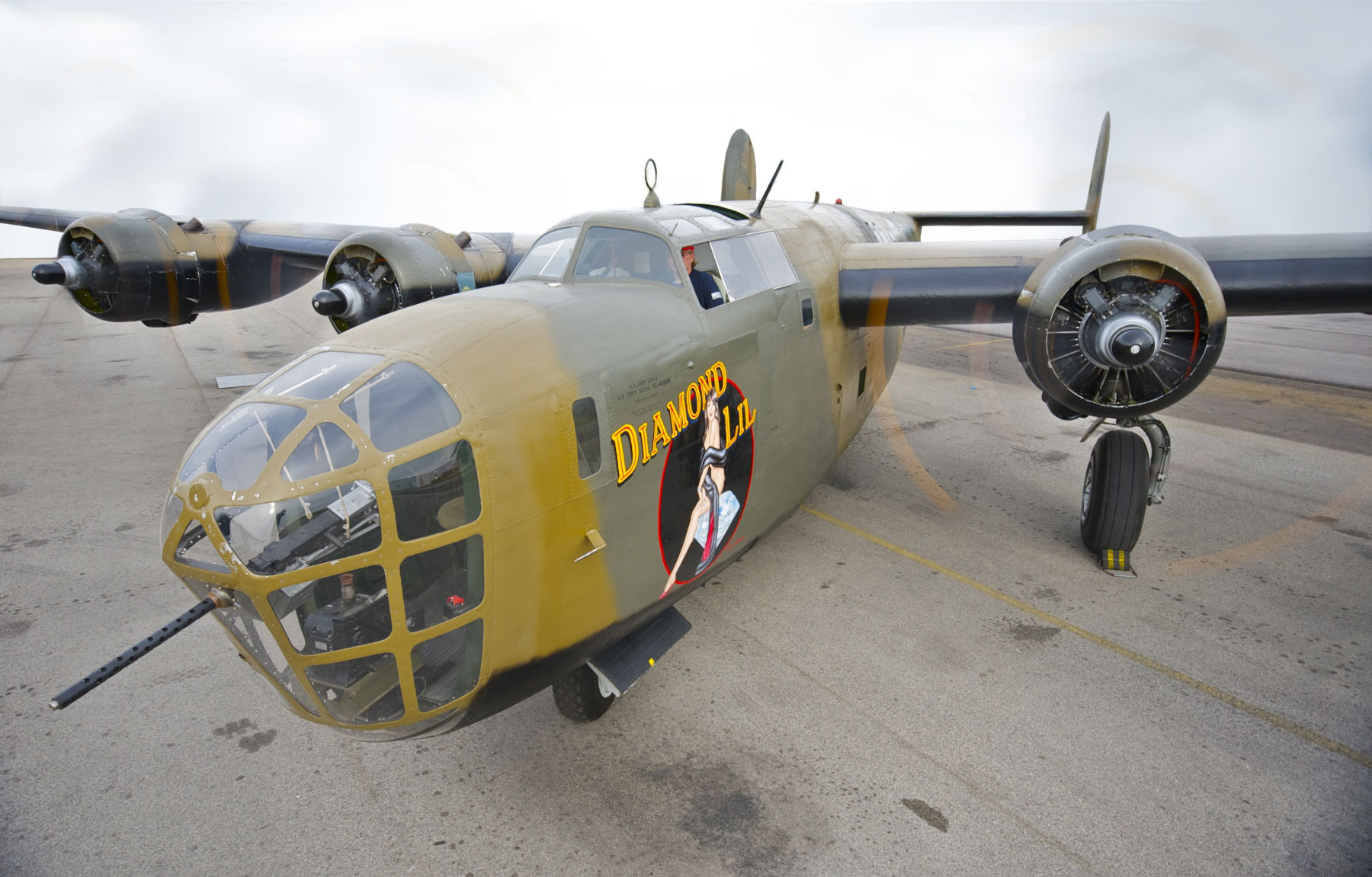


B-24 Liberator ���Diamond Lil���
JANESVILLE���On July 23-25, the Southern Wisconsin Regional Airport will take visitors back to the 1940s and recreate some of the wartime sights and sounds during Janesville���s Warbird Weekend.
The event is making its return this summer after a year lost to the pandemic. A World War II-themed celebration, Warbird Weekend honors the men and women who served during the war and showcases aviation titans from the era.
In conjunction with the Tri-State wing of the Commemorative Air Force���a nonprofit organization that acquires, restores and maintains the aeronautical relics���Warbird Weekend is featuring a dozen authentic warplanes.
���They���re the real deal,��� said Jacques Robitaille, CAF public information officer. ���They���re not replicas; they���re not mock-ups.���
According to Robitaille, the organization���s mission is to ���honor, educate and inspire.��� Visitors get a glimpse of the majestic birds of steel used in some of America���s most historic conflicts, both up close and in the sky.
���We are seeking to honor the men and women who built and flew these airplanes during the war,��� he said.
Pete Buffington, executive director of Warbird Weekend, said Janesville���s event a unique and ���fully-immersive��� affair.
���Our event sets itself apart by allowing attendees right out on the tarmac with the aircraft,��� he said. ���It brings a whole different level of appreciation as to what our vets did and what they sacrificed to defend our freedoms.���
Not only can people get an up close view of the planes, CAF pilots are slated to fly six of the aircraft on display.
Among the planes attendees will be able to fly in:

B-29 Superfortress ���Fifi���
B-29 Superfortress ���Fifi���
Originally built in 1945 and one of only two B-29s currently flying, the Superfortress, or ���Fifi,��� got its start as an administrative aircraft. It was one of the most advanced four-engine bombers of WWII, equipped with features such as remote-controlled gun turrets.
The CAF organization acquired the bomber, which was initially used in squadron training, in the early 1970s. ���Fifi is a movie star of sorts, having appeared in films such as ���Roswell,��� ���The Right Stuff��� and in an episode of the AMC TV series ���Better Call Saul.���
B-24 Liberator ���Diamond Lil���
More than 18,000 Liberators were built during WWII. Created as an update to the older B-17 bombers, Liberators could fly at more than 300 mph, had a 4,000-mile range and could hold up to 8,000 bombs.
The B-24 model was utilized in the British Royal Air Force in the early ���40s, later getting extensive use in the U.S. after the country entered the war. Due to its long-range capabilities, the Liberator was the go-to heavy bomber.
Diamond Lil got her start as a training aircraft for RAF pilots in Albuquerque, New Mexico. After sustaining significant damage after landing training, Lil was sent to San Diego, California, for restoration. While the damages kept the plane out of service as a bomber, it was utilized as a transport plane for various British companies.
The CAF took ownership of the craft in 1968, and it has been used in shows ever since.
P-51 Mustang ���Red Nose���
In 1957, Lloyd Nolen and several other ex-service pilots purchased ���Red Nose��� as one of their first planes to help the CAF take flight. A single-seat fighter, the P-51 Mustang was initially used by the RAF and later was adopted by the U.S. Army���s air forces.
A total of 15,567 such Mustangs were built for the Army and other nations. In combat, pilots in these planes destroyed nearly 6,000 enemy aircraft.
Equipped with a 360-degree-view bubble canopy and six 12.77-millimeter machine guns, the plane was the Allied forces��� deadliest fighter during World War II.
T-6 Texan
The North American T-6 Texan, also known as ���the pilot maker,��� was designed as a transitional trainer to prepare basic pilots for real world missions. Overall, several hundred thousand pilots earned their stripes behind the T-6���s cockpit.
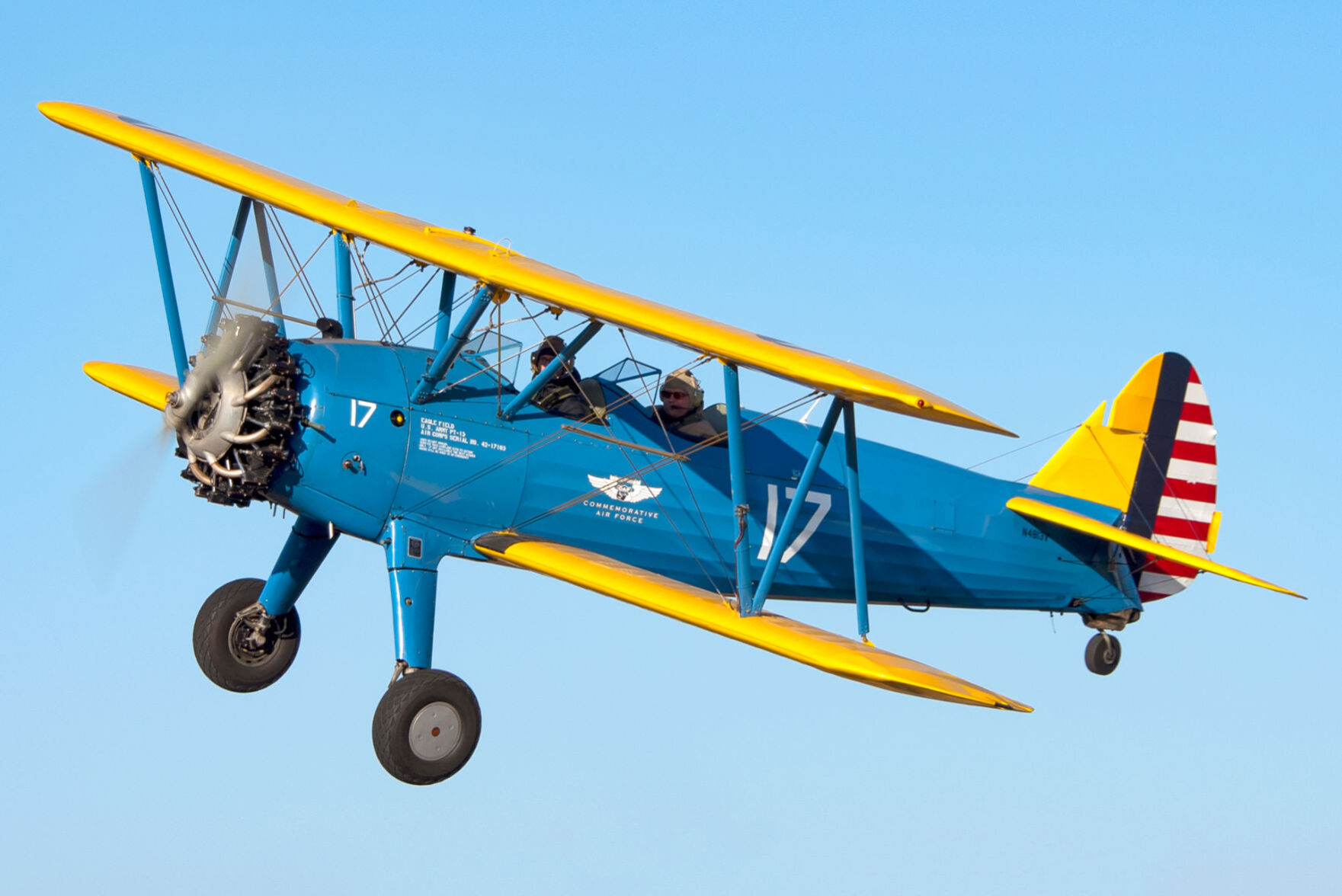
P-13 Stearman
P-13 Stearman
Known as the ���Kaydet��� by the Royal Canadian Air Force, the P-13 Stearman was used as a trainer in the U.S. in the ���30s and ���40s. The two-seat biplane saw peak production in 1940 when the prospect of war was imminent.
This aircraft has an open cockpit and fabric-covered wood wings.
SBD Dauntless
The Douglas SBD Dauntless saw its first flight in July 1935 and played a major role during the Battle of Midway in 1942, helping turn the tide in the conflict with the Japanese.
While not as fast as its peers, the Dauntless���s performance during the conflict earned it the nickname ���Slow But Deadly.��� It was the first to shoot down a Japanese Zero fighter and the only fighter plane used from the beginning to the end of World War II.
-
Greg Little
Kicks Editor


Steve Stettler
Steve Stettler
Steve Stettler has cheese in his blood. That might not sound healthy, but it’s likely the reason this third-generation cheesemaker has enjoyed great professional success as head of Brodhead’s Decatur Dairy.
A 1973 graduate of New Glarus High School, Stettler has been making cheese for nearly 50 years. He earned his first Master Cheesemaker certification in 1999. Since then, he has become a master cheesemaker of cheddar, brick, Havarti, Muenster, farmer’s cheese and specialty Swiss. Last year, he became the state’s first master cheesemaker of cheese curds.
Stettler’s cheeses have won countless awards including a world championship for Muenster in 2008. His Havarti has been grand champion at Monroe’s Cheese Days on three separate occasions.
Stettler runs Decatur Dairy with his wife, Glennette, who also is a master cheesemaker. The couple have three daughters, Sierra, Shaya and Amber, and several grandchildren.
To learn more about Stettler and Decatur Dairy, visit , search for @decaturdairy on , call 608-897-8661 or swing by the dairy store at W1668 Highway F, Brodhead between 8 a.m. and 5 p.m. Monday-Saturday.
1. Do you have a personal favorite type of cheese? I really like most cheeses. I grew up in a factory, and my dad made Swiss cheese. Having a Swiss cheese on hand is like the old days; it’s important to me. My uncle Gene made cheddar cheese and aged-out daisy cheddars. I liked aged cheddar from an early age. Brick, Havarti, Stettler Swiss and Colby Swiss are always in the fridge.
2. You come from a long line of cheesemakers. How will the family tradition continue on after you walk away from the vat? I am fortunate to have cheesemakers who are interested in and care about the product as our business now takes me away from production for phones calls, meetings and just running things. The family business has been such a part of everyone, and I do not see that changing. But change sometimes just happens with opportunity, and we have been fortunate throughout the years.
3. How does someone go about earning the master cheesemaker designation, and how many certifications do you hold? I have seven master cheesemaker certifications. One has to be a licensed cheesemaker in Wisconsin—the only state with licensed cheesemakers—for 10 years. You need accredited coursework through the Center of Dairy Research at UW-Madison and three years of sampling your cheese. It is a 13-year journey for those just getting into the business.
4. Share something people would be surprised to know about you. I was big into cattle showing in 4-H and won for showmanship one year. I messed around with the accordion but didn’t stay with it. In Jamaica, I jumped off of a 40-plus-foot cliff at Rick’s Cafe into a water hole on a dare from a New York guy.
5. Name something you’ve paired with cheese that you didn’t expect to taste good, but did (or something you did expect to taste good, but didn’t). Cheese spread on a hamburger. Customers were telling me it is great, and it is. I never thought blue cheese and steak would be good, but it’s awesome. Cheddar and apple pie? I still question that.
6. What are some of the misconceptions people have about the cheesemaking process? Cheese curds. Everyone thinks you just take them out of the vat. Curds are milled from fresh cheese that have gone through the make process.
7. How many pounds of milk do you use in a week to produce your cheeses? Decatur Dairy runs over 2 million pounds of milk a week. Milk averages 11 plus pounds of cheese for every 100 pounds.
8. It seems flavors of cheese continue to evolve. What are some of the more popular flavors out there today, and what drives this continued innovation? People’s tastes and interest in cheese has evolved from years ago. It has gone from mild young cheese to aged, strong, robust flavored cheeses
9. I understand all cheese is actually white. What goes into varieties such as Colby and cheddar to give them their orange hues? All cheese are white as milk is white. Swiss is a natural color, but the make process and higher heat, lower moisture and the warm room process to develop holes turns it a yellowish color. Cheddar, Colby and other varieties that are cream color have Annatto color added to the milk. Depending on what color you want will depend on what you add. (LOL ... a master’s touch).
10. Name a popular actor/singer/artist that doesn’t appeal to you. Any artist that uses his or her fame to endorse an agenda. Opinions are fine, but they seem to have to go farther than that. Turn the radio off.
11. What is your favorite food, and where is your favorite place to get it? Kalberwurst and rosti hashbrowns at Turner Hall in Monroe or Glarner Stube in New Glarus.
12. You have created a few of your own cheese varieties. Where do you get your ideas? I lie awake at night, and vats circle my head. Seriously, though? From conversation, drinking a beer, brainstorming and listening to conversations. Ideas come from anywhere and are usually out of the blue.
13. You have helped judge the World Cheese Competition in the past. What goes into judging cheese? Judging cheese is a grader’s opinion. Some might like less salt, a stiffer body or hints of flavor they feel should be there. Most agree on a middle road, but 1/100th of a point might be enough to knock you out. There is never a single judge but usually two per class. Judges look at the cheese, and one says first opinions count. Your cheese needs to look as good as it should taste. Flavor, texture and smell all count.
14. How much time does it really take to make cheese? All cheeses are different, and all phases take different amounts of time. Cheeses can take from 6 hours to 24 hours to 30 days. If cured, that is the longest process. There are too many variations.
15. Some people are afraid of spiders, some are afraid of clowns. Is there anything you’re particularly squeamish about? Damn snakes!
16. Do you speak any languages besides English? I know enough German to be dangerous and to get a bunch of laughter and free beers in Germany!
17. Do you collect anything? I like all things old that I had or was around growing up: beer signs, DX gas stuff, Swiss bells, old cheese equipment. And like everyone else, old cars, trucks and motorcycles.
18. Name a TV show or movie that, even if it’s halfway over, you will stop everything to sit down and watch. “Iron Resurrection.” Just to recreate a car or truck is interesting.
19. You have two hours of free time. What do you do? That just isn’t enough time! It would be like eating two Lays potato chips or cheese curds!
20. My wife will take a hunk of cheese out of the refrigerator, cut it and eat it immediately. I tend to let my cheese sit for a bit before eating it. Which one of us is doing it right, and why do you say that? You are correct, sir! Cheese should be tempered some before eating. When I plan to take curds somewhere, they usually sit on the counter all day. Limburger doesn’t know what a refrigerator is. My dad never put it in the fridge. The kitchen smelled wonderful.
dry leaf tobacco closeup on the white background