Snow cones and cotton candy. Nachos with cheese and jalape簽os. And let���s not forget corn dogs. When it comes to fairs, such as the Walworth County Fair in Elkhorn from Sept. 1-6, eating is a big part of the equation.
But fair cuisine shouldn���t put us in a food coma each year.
Consider this from Dr. Steven E. Nissen, chief academic officer for the Heart and Vascular Institute at the Cleveland Clinic: The world���s most atherogenic (i.e. promotes heart disease) food is a deep-fried Mars bar (a Mars-brand chocolate bar covered in batter and cooked in boiling fat).
Nutritional value? About 600 calories and about two tablespoons of fat per serving���most of which is the stick-to-your arteries saturated fat type.
Yes, fair time calls for momentary indulgences, but Nissen points out there is no known medicine we can currently take to counteract the excess junk we keep packing into our bodies ��� and not just at fair time.
At a recent conference sponsored by the University of Colorado Barbara Davis Center for Diabetes, Nissen said a poor diet is outdoing everything else medical experts have done thus far to reduce heart disease. How? Abdominal obesity (excess fat in our mid-sections) overflows into the liver, heart and muscles and interferes with the health of all these organs. That can eventually lead to heart disease, diabetes and a shortened life span.
So how do we enjoy our beloved fair food and not fall off the Ferris wheel from a stroke or heart attack? Here are some suggestions:
Be picky.
- There are plenty of ���this is probably a better choice than that��� among your usual fair food selections. Corn on the cob or turkey leg might be just as fun and a lot less damaging than fried chicken and gravy in a waffle cone. Or maybe an ice cold lemonade in place of deep-fried Oreos.
Question your choices:
- Ask yourself, ���How important is it to me to add this succulent hunk of fat and sugar to my body? If I eat this, will I feel A) intensely satisfied? B) like a bloated water buffalo? or C) like I had my day at the fair and all is right with the world? Then choose accordingly.
Remember, too, the dose makes the poison. Balance a day blown at the fair with a very light eating day afterwards.
Barbara Quinn-Intermill, a registered dietitian and certified diabetes educator, is author of ���Quinn-Essential Nutrition.��� Email her at to barbara @quinnessentialnutrition.com.
Airlines have had a tough time throughout the pandemic dealing with unruly passengers. From people who get drunk and molest flight attendants to fights breaking out over mask policies, it would seem that airline etiquette has degenerated.
A recent report by The Association of Flight Attendants found that a staggering 85% of flight attendants in the United States have dealt with an unruly passenger since the beginning of this year.
Is it because people have forgotten how to fly? Or is it that we’ve been so isolated we’ve forgotten how to be polite and maintain our calm in what has become a more stressful situation than in the past?
A recent survey from ValuePenguin asked more than 1,000 individuals from four generational categories in America what they think of airline etiquette, and what their biggest pet peeves were when traveling by air.
More than half of Americans (54%) believe that the pandemic has worsened fliers’ airline etiquette, with 24% mentioning that their poor behavior could cause a plane to turn around or not take off at all, ruining other passengers’ experiences and plans.
Seventy-four percent of respondents believe that being rude to flight attendants is the biggest breach of airline etiquette, yet the majority of the thousands of reported incidents occur between flight attendants and passengers over problems of verbal and physical abuse, as well as noncompliance.
The other problem is drunk passengers. The Federal Aviation Administration, or FAA, has warned airports that have bars or restaurants that serve alcohol to closely monitor signs of drunkenness and curb the rate of intoxicated individuals, as they found the rate of these incidents was climbing because of a correlation with alcohol abuse.
This has posed the question of whether or not airlines should pause serving alcohol onboard for the time being, which 81% of respondents agreed would be a good idea, with 65% noting that getting drunk in the air is not acceptable behavior. Earlier in June, United Airlines, Southwest and American halted their alcohol services in the hopes of reducing the rate of unruly passengers, according to .
The percentage of individuals who believe getting on an airplane while sick is a breach of etiquette has risen from 56% in February of 2020 to 67%—an 11% increase that surely has been affected by the pandemic’s all-important focus on human health and hygiene, though that number could be interpreted as lower than expected.
It’s important to remember to be kind and considerate to avoid adding to your or anybody else’s stress as travel continues to grow this year. Wear your mask when it is required. Air travel is considered public transportation, and masks are still mandated by federal law.
Noncompliance, especially when it becomes violent, can be charged as a federal crime. Be aware of others and give them greater personal space than before. Wash or sanitize your hands often and remember: always be kind to flight attendants.
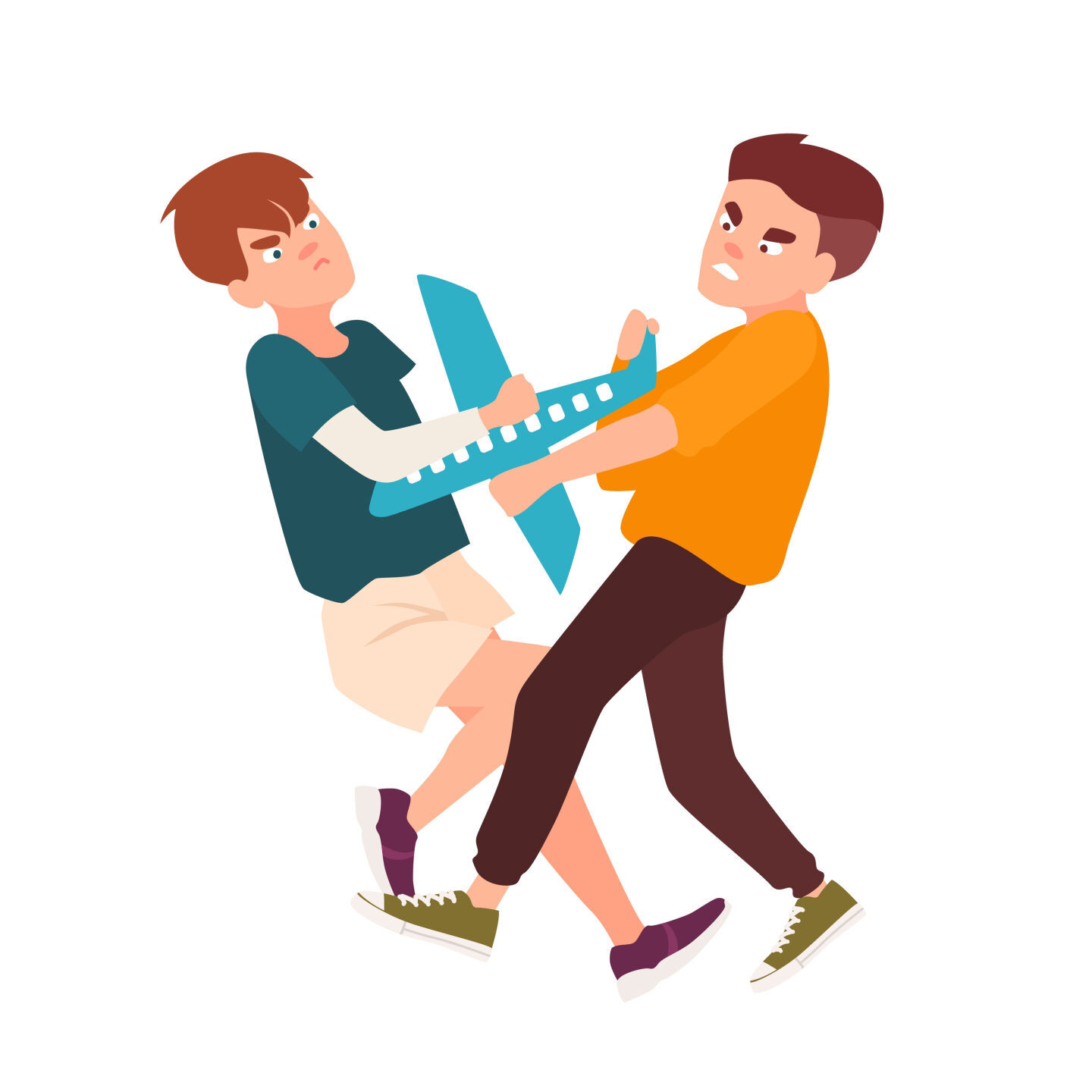
Pair of angry fighting children. Conflict between kids because of toy aircraft, violent behavior among teenagers. Cartoon characters isolated on white background. Vector illustration in flat style.
Q: Our preteen daughter does not like physical affection, such as hugs and kisses. She prefers to show affection in other ways. Her dad and I have pretty much come to grips with that fact (though we would love to have hugs and kisses again).
However, her grandmother, who has been in her life very regularly since she was born, either does not understand or does not care. She always begs for hugs and kisses and it really makes our daughter uncomfortable.
We’ve tried explaining to my mother-in-law that our daughter isn’t comfortable with physical affection, but she continues to ask and has occasionally indicated that we need to force the affection.
It’s gotten to the point where our daughter doesn’t like to visit her grandmother anymore because of the issue.
Should we let her skip these visits to make it clear to her grandmother that she’s putting too much pressure on her granddaughter?
—Anonymous
A: Yes. Respect her right to remove herself from situations where she is denied control over her body, especially after she has spoken up clearly on her own behalf.
Good for her for being ready to attach consequences to this disrespect. That will serve her well, and it’s a self-governing impulse that warrants full parental support.
When (inevitably, right?) her grandmother protests her decision, speak plainly on her behalf: “She, and we, have made clear she is not comfortable being touched, and you have not respected that.”
To any howls of protest over drawing a line this hard (I will hear them, too, be assured), please respond: “Are you suggesting her body is more yours than hers?”
Because—as I shamelessly steal from a talking point about a different issue—we don’t force people to donate their organs, right? After people die, we bury them intact if that’s what they requested, even though they (presumably!) won’t even know either way. So that bedrock principle doesn’t just vanish because Gamma wants a hug. We do not get to do this, to co-opt other’s bodies to get our own needs met.
If it costs something so precious as the bond between a grandmother and grandchild, then responsibility for that loss falls squarely on the one who would do the co-opting, not on you or your girl.
Q: I have to use the subway to commute to work. Every day it seems more and more people are riding the train without a mask on, despite the law that states it’s required on public transport.
I do what I can to avoid sitting near these people—I try to sit in the first car of the train in hopes it’s less populated, and I change seats when possible if someone maskless sits near me.
I’m vaccinated, but the delta variant surge is a scary thing. I’m also seven months pregnant. If I could drive to work, I would. But public transport is my only option. Besides playing musical chairs and rolling my eyes, is it my place to say something to the maskless? If so, what do I say?
Clearly the subway employees aren’t enforcing their own masks rules. I find it all very frustrating. No one likes wearing masks. But it’s such a simple thing to do for the common good and it’s obnoxious that people don’t wear their masks on public transport—of all places!
—Masked Rider
A: While the foundation of this column is personal responsibility, sometimes the responsibility we bear is to hold others accountable for doing their jobs for us. Unsafe public transportation is not something you can fix alone, stranger-by-unmasked-stranger as you speed along with them in a sealed canister underground.
I wish I could wave a cursor to change people’s ignorant or thoughtless or reckless or selfish behavior, but you’re the one who needs to use your power.
Complain to the administrator in charge of public transportation, and also to your local board of health. And, your energy permitting: to your city’s executive; to your neighborhood’s elected representative; to everyone, from the top to the bottom of the city government org. chart. Ask them to answer the question you asked me. Be the source—again, energy permitting—of unrelenting civil pressure to get these mandates enforced. Use social media, if you’re thick-skinned enough, to rally others to apply pressure as well.
And of course talk to subway employees directly. Apparently they need a pregnant woman in their faces every time they slip off their masks, and every time they give others their tacit permission to flout the rules by doing nothing about it. I’m sorry this burden’s devolving to you. And to them, truly, since no doubt they’re exhausted, like every public-facing employee right now. But too much recklessness has left us with no other choice.
Email Carolyn at tellme@washpost.com, follow her on Facebook at carolyn.hax or chat with her online at 11 a.m. each Friday at .

Sending love message in pop art style. Hand holding phone with love heart on screen.
It���s no secret men and women are different. I���ve been seeing that difference compounded in my clients when it comes to dating apps such as Tinder and Bumble.
Men and women, regardless of orientation, use the apps in a different manner from each other. Of course, this is a generalization, and there are exceptions to every rule.
But I want to share some insights on the way people approach the dating apps, as I���ve learned from coaching clients.
It starts the same for both sexes: You see someone���s first profile picture. You don���t like it. You swipe left. (Swiping left means you don���t like someone; swiping right means you do.) Done.
Now, here���s where the decision tree takes a turn. As women, if the first picture passes the test, then we look at the remaining pictures.
Gym selfie? Swipe left.
Holding a slimy fish? Swipe left.
Unnecessary shirtless pic? Swipe left.
Pictures with lots of hot women? Definitely swipe left.
If we���re still on the ���yes��� train, now we spend some time looking at the profile. (I recommend 25 to 40 words, something catchy, something quirky and something unique.)
We look to see what, if anything, the other person has written. Nothing? Likely a left swipe. Something with poor grammar, anything remotely sexual, or something very negative? Also a left swipe.
Now, once we view all of your pictures, find none of the faux pas above have been made and we also like your profile, we swipe right. Decision complete.
Many men, on the other hand, if they like the first photo, will immediately swipe right. Decision complete.
So men are often using the app liberally to see who matches with them, whereas women use much more discretion and only swipe right on people who might be a good fit.
Do you see a mismatch here? I do. So do my clients.
When a woman matches with someone, she thinks it means something. She writes a message ��� and nothing. On the other end, someone is only now reviewing her whole profile, making a decision, and then replying or not based on that decision. This leaves many women upset that their messages go unanswered.
I certainly understand the temptation to swipe right on everyone just to see the whole pool of those who are interested, but I wouldn���t recommend it.
Here���s my advice:
- Take the extra time to review someone���s whole profile before making a decision.
- Write some text in the profile.
- Keep it short, funny and light.
- Send messages to the people who you match with.
- If you decide later that this person isn���t for you, unmatch before any communication happens.
Even if you just take one thing from this article, the world of dating apps will be more rewarding.
Erika Ettin is founder of ���A Little Nudge,��� where she helps others navigate the often intimidating world of online dating. Join her newsletter, eepurl .com/dpHcH for tips.