Southwest Airlines is asking flight attendants to sell credit cards during flights in exchange for a smaller pay cut as the company tries to navigate expected losses from the COVID-19 pandemic.
Southwest, which told union employees earlier this month they need to take a 10% pay cut next year to avoid furloughs, could start selling products during flights, including credit cards, as a way to increase revenue and make up for the dismal number of passengers booking fares.
The credit card pitches came up during a bargaining session this week between Southwest and Transport Workers Union Local 556, representing the 15,000 flight attendants at the carrier, according to a summary of the meeting sent to union members. Southwest declined to comment.
The airline is in a dire financial position as it heads into 2021 and is looking for ways to boost revenue and cut costs. That���s why the company recently announced expansion plans to airports such as Chicago O���Hare, Houston Intercontinental, Miami and Palm Springs, Calif., an attempt to broaden its revenue base while a large number of passengers are still unwilling to fly.
Losses are expected to be steep once again for Southwest when it announces its third-quarter results. Delta Air Lines reported a $5.4 billion loss for the quarter and United Airlines lost $1.8 billion.
Southwest CEO Gary Kelly and other airline executives have said they don���t expect a significant rebound in airline traffic until a COVID-19 vaccine is developed and distributed, which likely wouldn���t happen until late 2021.
Southwest has never slashed pay or furloughed employees in its 50-year history. Kelly said the company is looking at a myriad of options to avoid it, including new ways to make money and cut expenses.
Southwest is the only major airline that doesn���t try to sell credit cards during flights, one of a handful of ways it sets itself apart from other carriers, along with its bags-fly-free and no-first-class policies.
Credit card and loyalty programs are a major revenue stream at other airlines. Airlines don���t disclose exactly how much they make from selling credit cards on board, but Southwest said it made $1.3 billion last year from its various credit card programs and agreements with banks.
Selling credit cards during flights often brings in revenue for each new card, as well as potential cash when customers use those credit cards.
In the past, Southwest has turned to other means to sell credit cards than pestering passengers, such as emails and partnerships with country music stars.
The airline would need the flight attendants union to sign off on the on-board credit card pitches because they would be the ones selling the cards. The topic came up in negotiations for a new contract last year, but those talks have slowed because of the uncertainty of the pandemic.
So far, unions have been icy toward the idea of pay concessions. TWU Local 556 president Lyn Montgomery said that historically pay cuts haven���t resulted in fewer furloughs at other airlines.
���Now, while flight attendants are serving on the front line of the pandemic, they are doing so with limited opportunities to earn what they had before, while the company is asking for pay concessions that would result in a further reduction to their paychecks,��� the union negotiating committee said in its letter to members.
Coca-Cola said it is dropping half its drink brands, most of them sold outside the United States.
All told, the 200 brands slated to be discontinued account for only about 1% of the company���s profits. They consume too much attention and resources, Coke leaders said.
Meanwhile, the Atlanta-based beverage giant reported continued financial pain from the pandemic. The company���s chief executive said that���s easing, but warned ���the world is in a fragile state.���
Coca-Cola previously announced eliminations of Tab, the company���s first diet soda, as well as Zico coconut water, Odwalla juices, Coca-Cola Life, Diet Coke Feisty Cherry and a few regional players, including Northern Neck Ginger Ale and Delaware Punch. They will be discontinued in coming months.
No other North American brands are expected to be phased out this year, a company spokesperson wrote in an email to The Atlanta Journal-Constitution.
In other nations, the company is dropping brands such as Vegitabeta in Japan and Kuat in Brazil.
The company said the moves free up resources to expand more successful brands and newer ones, including Topo Chico Hard Seltzer, Coca-Cola Energy and AHA flavored sparkling water.
In the announcement, Coke also reported its latest third quarter results: Revenue fell 9% and operating income was off 8% compared to the same period a year ago. But the results were better than they were in the spring, when revenue decreased 28% and income was down 34%, one of the worst quarters in the company���s 134-year history.
In the latest quarter, the case volume of beverages sold was off 4% compared to a year ago. In the spring, it was down 16%.
James Quincey, Coke���s chairman and chief executive officer, said he is encouraged by recent improvements.
But in some markets there have been a return to restrictions on businesses and gatherings. Half of the company���s global business is generated in places such as restaurants and entertainment venues, spots hit by lockdowns and consumer concerns about social distancing.
In August, Coca-Cola offered voluntary separation packages to 4,000 employees in the United States and Canada���nearly 40% of its staffers in those areas. Workers in other countries faced cuts as well. Company leaders haven���t said how many total employees will leave Coca-Cola through voluntary or involuntary reductions.
General Motors is revving up excitement with an all-new kind of Hummer.
The car manufacturer recently introduced its upcoming Hummer EV, a massive, fully electric vehicle that���s slated to go on sale in fall 2021.
Described as ���the world���s first all-electric supertruck��� by GM, the 1000-horsepower Hummer EV is expected to be capable of traveling at a range of about 350 miles on a full charge.
���As the world���s first zero emissions, zero limits all-electric supertruck, HUMMER EV generates the power and technology to conquer the off-road with extraordinary confidence,��� GM says on its website. ���The revolutionary Detroit-built HUMMER EV will leave everything you thought possible in a cloud of dust.���
The first edition of the Hummer EV is expected to sell for a little more than $112,000 next year, with a cheaper model rolling out annually from there, GM says.
Previous models of Hummers were known for getting low gas mileage, but the new electric car���s makers say the Hummer EV will be capable of charging up for a range of about 100 miles in just 10 minutes.
���It may be quiet,��� GM says of the vehicle, ���but HUMMER EV���s revolutionary technologies and unmistakable design speak loudly.���
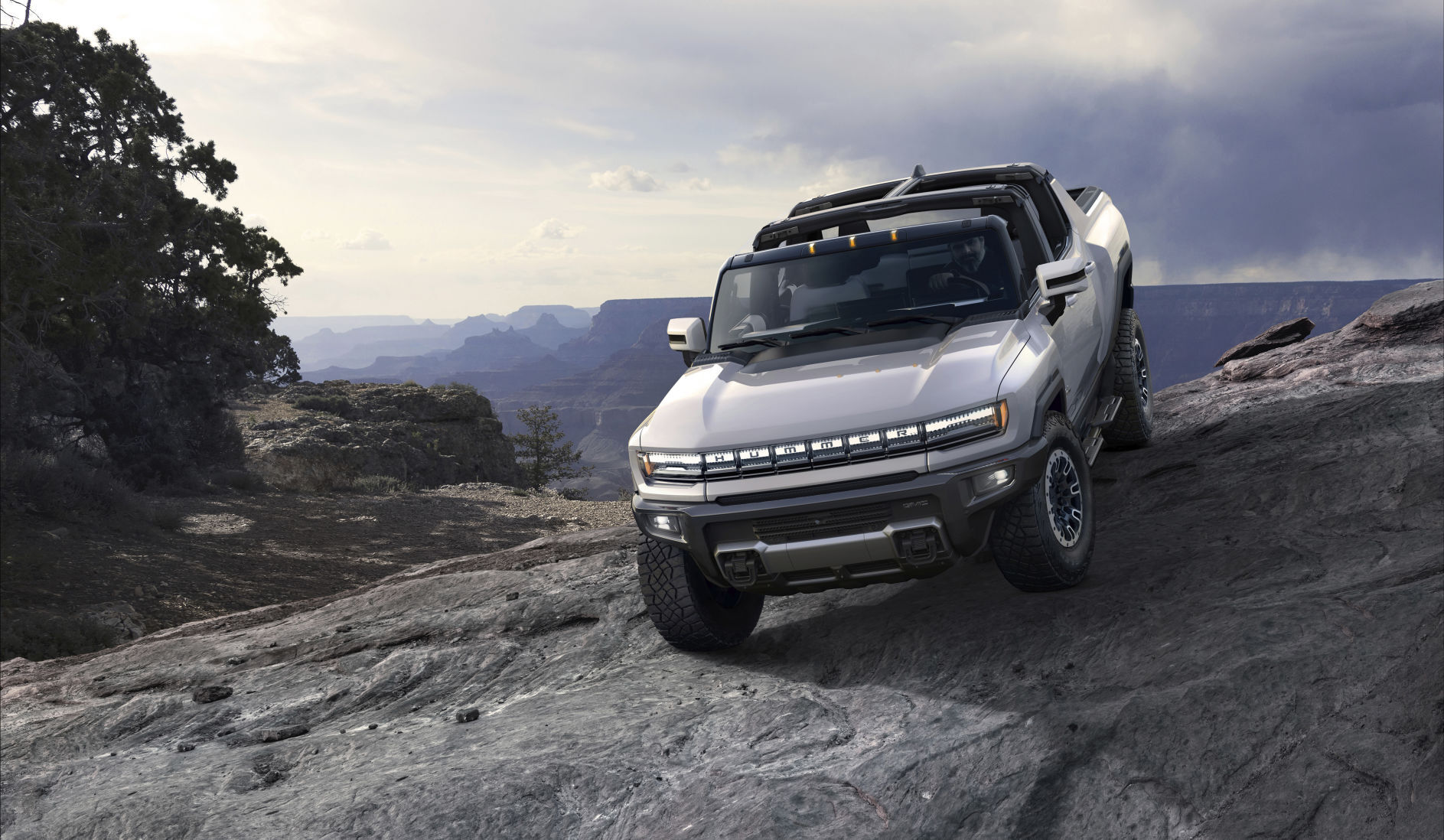
This photo shows the 2022 GMC Hummer EV. Earlier this month, General Motors��� GMC brand introduced the new electric Hummer pickup with a high-end version due in showrooms in fall 2021.
A new program, called Huntington Lift Local Business, will target entrepreneurs who have been hard hit by the pandemic by offering loans to small businesses owned by minorities, women and veterans.
What���s different about this program is that the loans may be very small, possibly $1,000 or $5,000���the kind of loans that a big bank such as Huntington would never have found economically feasible to make in the past.
But maybe it���s something that could enable someone who lost a job during the pandemic to start a small lawn care business, offer child care from home or other service.
���Most banks don���t make really small, what I would call microloans,��� said Stephen Steinour, Huntington���s chairman, president and CEO. ���We���ve never done anything like this, which is why it���s only $25 million.���
The objective here is to reach out to community groups, such as the Urban League or the NAACP, and religious communities to connect with potential borrowers who either are running a small business or want to start one.
���Frankly, I don���t think we���ll have a massive amount of $1,000 loans, but we���ll probably have some. And we���ll probably have even more $5,000 and even more $10,000 loans.���
Even during a time of economic uncertainty, he said, many people want to launch a new business. They���re willing to work hard, be innovative, and they don���t want to be victimized by an economic slump.
���We can do good at a period of stress for many of these businesses,��� Steinour said. ���If we can do this, I think we can really help neighborhoods.���
Steinour noted that the bank was willing to work with auto dealers when others were less willing to take on the risk during the auto downturn in 2009-10. The small-business strategy, he said, is similar during the economic stress created by the pandemic.
���It���s a very uneven recovery,��� Steinour said. ���The cities can be doing well, but not everyone participates.���
While the U.S. economy experienced a severe dip earlier in the year as a result of the COVID-19 health crisis, the economic rebound was significant in the summer.
Recent numbers, Steinour said, indicate that we���re seeing a continued economic recovery but at a moderating pace.
���Things like a flairup of the virus���which we���re seeing right now���could slow down the economy,��� he said.
The $25 million program will provide Small Business Administration guaranteed loans for as little as $1,000 and up to $150,000. In addition, the SBA fees would be paid by Huntington.
The program also will have no origination fees and offer flexible, longer-term repayment options.
Steinour said the bank will do some level of underwriting for the SBA for existing businesses, and the bank will require a new business to take courses offered through Operation HOPE at no charge to learn what running a business is like.
Borrowers could be able to qualify for the loans even if their FICO credit scores are as low as 580 or higher.
Steinour said the bank will likely lose money on some of these loans but over time a business might grow, thrive and be able to take on a much bigger loan.
The average size SBA loan that Huntington made last year was $155,000.
Many economists and others have noted that minorities who run small businesses are at greater risk now, as restaurants, retailers and others struggle to regain their footing in 2020.
The number of active business owners in the United States plummeted by 3.3 million or 22% from February to April, according to the National Bureau of Economic Research.
���The drop in business owners was the largest on record, and losses were felt across nearly all industries and even for incorporated businesses,��� the report noted.
The impact was even more significant for businesses owned by Black people, immigrants, other minorities and women.
���The negative early-stage impacts on minority- and immigrant-owned businesses, if prolonged, may be problematic for broader racial inequality because of the importance of minority businesses for local job creation (disproportionately for other minorities), economic advancement, and longer-term wealth inequality,��� according to the report���s author Robert W. Fairlie, an economics professor at the University of California-Santa Cruz.
The Columbus, Ohio-based bank holding company has been rolling out a variety of programs that are pitched as ways to help consumers and small businesses work their way through the economic challenges ahead.
In early September, Huntington put a five-year, $5 billion plan on the table in Michigan that will target making investments, granting loans and engaging in philanthropic efforts to improve financial opportunities for businesses, consumers and communities.
Huntington also has introduced a 24-hour grace period for business customers, where commercial customers are given additional time to cover overdrafts on their checking accounts. The service copies one that���s already offered to consumers.
Small business owners who participate in the Huntington Lift Local Business program also will have access to checking accounts with 24-Hour Grace overdraft fee relief, and see the service fee waived for 36 months.
As the U.S. economy bounced back from the COVID-19 spring shutdown, consumers found new cars in short supply and opted instead for used cars at higher prices.
Increased demand and higher used-car prices boosted net profits for mega-dealer AutoNation by 83% in the third financial quarter of July 1 to Sept. 30, the company reported Wednesday.
For the quarter, AutoNation reported $183 million in net profits from continuing operations, compared to $100 million in the third quarter of 2019.
The improvement brought record earnings for shareholders. Adjusted earnings per share from continuing operations was a record $2.38���a 102% increase over the previous year���s $1.18.
The result included a $28 million charge related to the company���s closing of its collision parts business.
AutoNation���s share price on the New York Stock Exchange was up 7.6%, to $67.83, in mid-morning trading on the news.
���In the third quarter, we saw solid demand and a strong pricing environment due to low-interest rates and increased interest in vehicle ownership from consumers,��� CEO Mike Jackson said in a prepared statement. ���With increased demand and tight inventory, we adjusted pricing and were able to grow our margins.���
Revenue dipped slightly, from $5.46 billion to $5.4 billion, and overall car sales declined by 7,186. Revenue from new-car sales declined by $126.4 million, but that was mostly offset by a $114 million increase in used-car sales.
Gross profit increased by 41% for new-car sales and 59% on used-car sales.
Same-store gross profit per new vehicle sold through retail stores increased $966 or 28%, while same-store gross profit per used vehicle sold through retail stores increased $602, or 43% compared to the previous year.
AutoNation owns and operates more than 325 locations across the United States.
Faced with fewer new vehicles from manufacturers beset by COVID-19-related production slowdowns, AutoNation beefed up efforts to acquire used-vehicle inventory.
The company���s ���We���ll Buy Your Car��� campaign resulted in the company buying more than twice as many used vehicles���more than 12,000���compared to last year. Seventy-five percent of used vehicles sold through retail channels were purchased from customers, the company said.
Buying from customers helps reduce average vehicle acquisition costs and boosts profit margins.
Cost of sales, which includes selling, general and administrative expenses, was 64.4% of gross profit during the quarter, compared to more than 70% the year before and well below the company���s running goal of 68%.
With used-vehicle sales continuing to grow as a share of AutoNation���s business, the company affirmed its intention to build more than 100 AutoNation USA used-vehicle stores, with more than 50 completed by the end of 2025. The first two will be opened in Texas, in Austin and San Antonio, by year���s end.
Stewardess. Woman hostess professional blue uniform of boarding airplane girl vector cartoon characters. Stewardess and hostess attendant illustration
Google plans to hire 10,000 workers in four cities over the next five years, with a focus on recruiting Black talent as part of the company���s racial equity commitment announced in June.
The company declined to say how many positions will be in each city or the types of roles that will be filled, but said it will start hiring 1,000 workers across its Chicago, New York, Atlanta and Washington, D.C., offices by next year.
In a company blog post Thursday, Google CEO Sundar Pichai said the technology giant will increase diversity goals for its workforce, suppliers and entrepreneurial partnerships.
Google plans to more than double the number of Black employees by 2025, Pichai said. In June, the company announced it would improve representation of underrepresented groups in senior level positions by 30% by 2025.
In Chicago, Google has more than 1,300 employees at its 50,000-square-foot office space in the city���s Fulton Market district.
The Tribune in November reported Google was close to a huge expansion of its Chicago real estate footprint, in which the tech giant sought to add an additional 800,000 square feet in two buildings Sterling Bay planned to develop. But those deals were never completed, and Google backed off the plans earlier this year during the coronavirus pandemic, according to people familiar with the plans.
It���s unclear whether Google might eventually revisit those deals with Sterling Bay, at 345 N. Morgan St. and 1000 W. Carroll Ave., or instead seek out space in other office buildings under construction in the former meatpacking neighborhood.