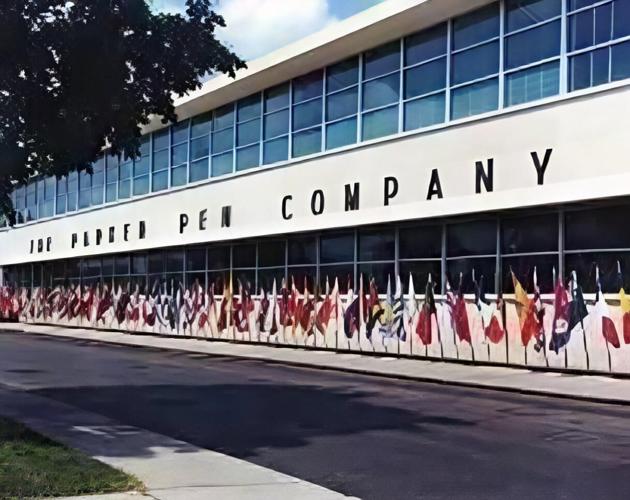
Parker Pen opened its Arrow Park headquarters in 1953. The new state-of-the-art, 226,000-square-foot headquarters was built on 28 acres on what was originally Bluff Street, renamed S. Parker Drive.
JANESVILLE -- For more than a century, Janesville was known worldwide as the home of the Parker Pen Company.
When a stranger asked a Janesville resident what the city was noted for, ���Parker pens��� was a good answer.
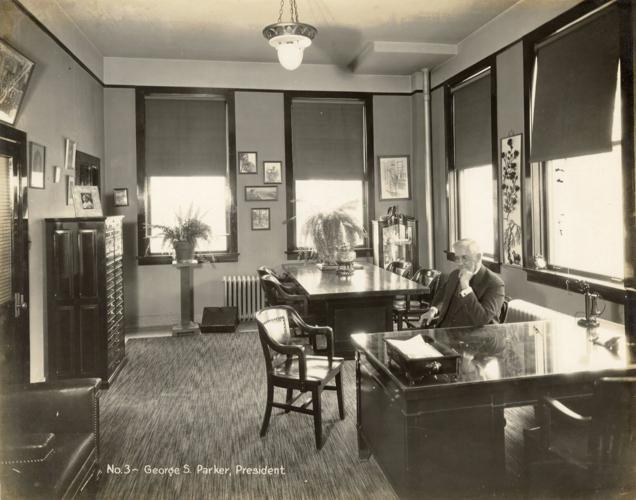
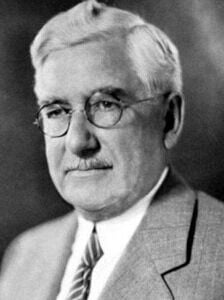
George S. Parker in his office at Parker Pen in Janesville.��
COURTESY ROCK COUNTY HISTORICAL SOCIETY
With thousands of employees working in Janesville and international distribution, Parker Pen set, throughout the 20th Century, the gold standard for fine writing instruments.
But what became the largest pen manufacturer in the world developed from a humble start.
The company was incorporated in 1892, spurred by the individual efforts of founder George Safford Parker, and through his deep connections with people in the Janesville community who trusted ��� and financially backed ��� his vision.
George S. Parker officially launched his quest to make a better fountain pen in 1892, about four years after he came up with the idea for the business while living in a small apartment at the Myers House hotel at Main and Milwaukee streets in downtown Janesville.
Early life
George S. Parker��
69蹤獲 file photo
The descendant of British immigrants who had sailed to America in the 1630s, Parker was born in Shullsburg, Wisconsin, on Nov. 1, 1863. He grew up on a farm in Iowa, in near poverty. His mother had advised him that he wouldn���t make a good farmer, and he looked for an alternate vocation.
After a brief stint at Upper Iowa University in Fayette, Iowa, Parker saw a newspaper ad recruiting students to the Valentines��� School of Telegraphy in Janesville.
With $55 in his pocket for tuition, Parker boarded a train and arrived in Janesville in 1882. After a year of study, he was hired as a telegraphy station manager in South Dakota for the Chicago, Milwaukee and St. Paul Railroad. Just a few months later, he was called back to the Janesville school to be a telegraphy instructor. He later became Valentines��� School of Telegraphy���s head instructor.
While teaching telegraphy in Janesville, he took a room at the Myers House hotel, and that���s where the seeds of Parker Pen were planted.
Tasked with trying to repair his students��� leaky fountain pens, he began to design a better fountain pen, working out of his room in the hotel.
To supplement his income as a telegraphy instructor, Parker was at the time also selling pens for the John Holland Pen Company, of Cincinnati, Ohio. He found those pens also to be leaky and unreliable.
Parker began manufacturing pens on a small scale in 1888 with just 11 employees operating out of the top floor of the Myers Opera House on East Milwaukee Street, which was connected to the Myers House hotel. He obtained his first patent in 1889.
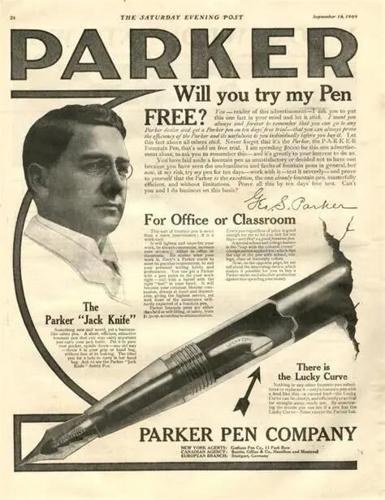
A 1909 Parker Pen ad in The Saturday Evening Post.
GAZETTE PHOTO
On March 18, 1890, Parker secured an additional patent, improving ink flow. He secured yet another patent on June 30, 1891, that further improved ink flow in fountain pens.
When Parker Pen Company was incorporated in 1892, William F. Palmer was its first president, Parker was its secretary-treasurer and Fred Lippert, M.F. Barnett, Frank A. Laetz and H.J. Gleason were inaugural board members.
To get off the ground, Parker partnered with William F. Palmer, a Janesville insurance entrepreneur, who wrote a $1,000 check payable to the Parker Pen Company at the time the company was incorporated.
Parker also secured a loan from Will Jeffris of the Merchants and Mechanics Savings Bank on West Milwaukee Street with no collateral, a sign that the bank had faith in Parker and in the newly-formed pen company.
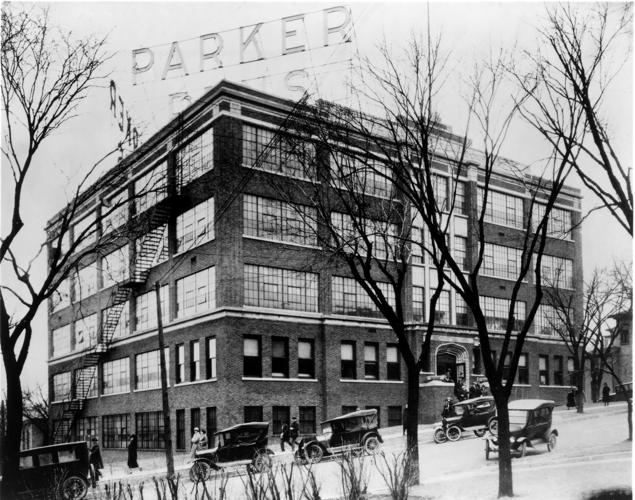
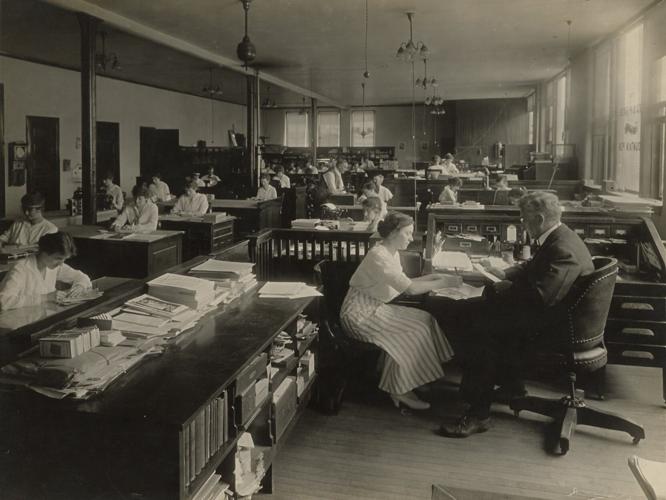
Parker Pen operated out of this office at Court and Division streets from 1920 to 1953.
COURTESY ROCK COUNTY HISTORICAL SOCIETY
The Merchants and Mechanics Savings Bank had been organized in 1875, with David Jeffris its first president. The Jeffris family in Janesville had significant local banking ties and longtime involvement in the community.
Another Jeffris family member, Bruce M. Jeffris, would later serve as the Parker Pen Company���s secretary and treasurer and as its president. In 1934, Bruce M. Jeffris would marry Eleanor Jackson, a widow whose first husband, Russell C. Parker, had been a Parker Pen vice president and general manager.
Their son, Thomas M. Jeffris, carried on a tradition of community service and philanthropy through the Jeffris Family Foundation in Janesville. The mission of the foundation, still in existence today, is to preserve Midwest history and heritage.
Dr. Henry Palmer, a prominent local physician and for a time president of the Merchants and Mechanics Savings Bank, would also be supportive of Parker���s growing business, as would be the Palmer family in general.
Dr. Henry Palmer���s son, William Palmer, would serve as president of the Parker Pen company in the 1890s.
Family life
The year 1892 was significant for George S. Parker, beyond fountain pens.
George S. Parker II
Courtesy Rock County Historical Society
At age 29, Parker married Martha M. Clemens on Thanksgiving Day, Nov. 24, 1892. At the time, it was said, Parker married at a relatively late age because of his preoccupation with establishing his company.
George and Martha Parker welcomed a son, Russell, on Sept. 16, 1893 and a son, Kenneth, on April 8, 1895. A daughter, Virginia, was born in 1901.
Parker Pen opened its Arrow Park headquarters in 1953. The new state-of-the-art, 226,000-square-foot headquarters was built on 28 acres on what was originally Bluff Street, renamed S. Parker Drive.
COURTESY ROCK COUNTY HISTORICAL SOCIETY
It is assumed that Parker and his new wife visited the Chicago World���s Fair ��� the World's Columbian Exposition ��� in 1893. That trip inspired George S. Parker to secure exhibitor spots for Parker Pen at the 1901 Pan-American Exposition in Buffalo, New York, and at the 1904 World���s Fair in St. Louis, Missouri.
Lucky Curve
Meanwhile, Parker Pen kept growing and drawing accolades.
Called revolutionary for its day, a patent for Parker Pen���s Lucky Curve feed was issued on Dec. 12, 1893. The Lucky Curve pen was introduced by what at the time was a groundbreaking marketing practice ��� direct advertising. The ad called the new pen design ���a scientific improvement. See that it has the Lucky Curve.���
The Lucky Curve advertising campaign was so successful it lasted for 35 years.
In December 1898, Parker Pen received international acclaim when a Parker #023 Jointless Lucky Curve pen was used to sign the Treaty of Paris, ending the Spanish-American War.
Parker Pen���s achievements continued well into the 20th Century, with not only its products being embraced internationally, but its manufacturing crossing into new territory, as well.
According to the website , annual sales exceeded $1 million for the first time in 1918.
A Parker Pen factory was established in Toronto in 1923.
Parker Pen executives stand near a company plane early in the 20th Century.
COURTESY ROCK COUNTY HISTORICAL SOCIETY
In 1945, General Dwight D. Eisenhower signed the World War II German surrender with a Parker 51, according to . Historical accounts noted a few years later that President John F. Kennedy liked to sign official documents with a Parker Pen.
Making headlines in those years was the company���s long reluctance to enter the ballpoint pen market.
Company leadership indicated it would not introduce a ballpoint pen until technology was developed to make a quality ballpoint. When that day finally arrived, in 1954, Parker introduced what became the Jotter ��� and the rest is history.
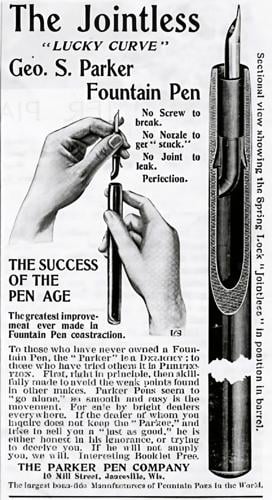
An early ad for Parker Pen and its ���Lucky Curve,��� shows that it was then located at 10 Mill St. in Janesville.
The Jotter simply defined ballpoint writing instruments, and its use exploded, according to historical accounts, with 3.5 million sold in its first year.
The launch of the Jotter closely coincided with Parker Pen moving from its headquarters it had occupied at Court and Division streets since 1920 to a new location, Arrow Park, in 1953. The new state-of-the-art, 226,000-square-foot headquarters was built on 28 acres on what was originally Bluff Street, renamed S. Parker Drive.
Earlier in its history, around the turn of the 20th Century, ads show that the company was located at 10 Mill St. in Janesville.
A prominent feature of Arrow Park was the Path of Nations, featuring the flags and stones of the 85 countries where Parker pens were sold.
Family succession
Meanwhile, the Parker family remained at the helm.
Company founder George S. Parker died on July 19, 1937, at the age of 73. He was buried in Oakhill Cemetery in Janesville.
His son, Kenneth S. Parker, assumed the role of president from 1937 to 1960.
Another son, Russell Parker, vice president and production manager, had died in 1933, at the age of 39.
Parker Pen operated out of this office at Court and Division streets from 1920 to 1953.
COURTESY ROCK COUNTY HISTORICAL SOCIETY
George S. Parker II, the son of Russell Parker, was president from 1966 until his retirement in 1977, overseeing operations as the company continued to grow and eventually employed 2,000 skilled workers.
In 1993, Parker Pen was purchased by Gillette Company, which announced that all of its pen manufacturing was being moved to the United Kingdom.
Only a Parker Pen special markets division and a repair facility remained in Janesville.
Dave Duranti remained employed in Janesville, for a while. He was finally let go in 1999, after 36 years with the company.
���It was just devastating,��� Duranti said. ���Parker Pen was a great place to work. It was the kind of place you hoped to retire from.���
Duranti has good memories of working at Parker Pen, especially early in his tenure.
While working in the stock room, he recalls occasionally being asked to run errands, including to Howard���s Soda Fountain to buy tobacco products for company executives.
���If memory serves me correctly, George Parker and Bruce Jeffris smoked Benson & Hedges cigarettes, and Dan Parker smoked Revelation pipe tobacco,��� he reflected.
The official end of the Parker Pen Company in Janesville came in 2009 when then-owner Newell Rubbermaid announced it was closing down all Parker operations in Janesville. It moved production to Mexico and administrative operations to Oak Brook, Illinois.
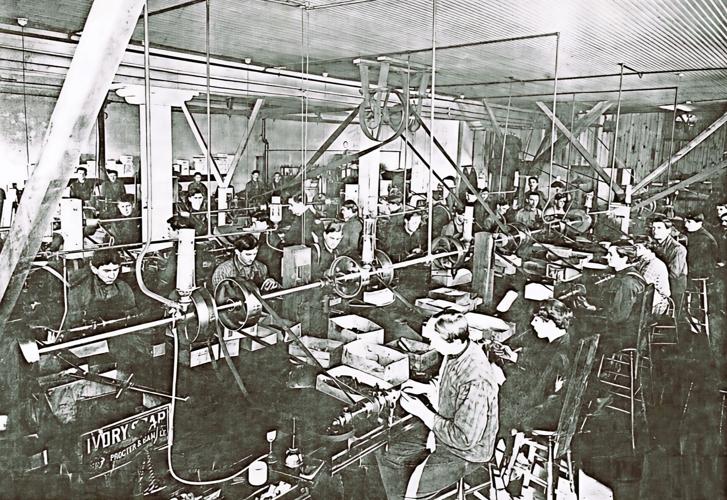
The Parker Pen factory floor in an undated photo.
COURTESY ROCK COUNTY HISTORICAL SOCIETY
Newell Rubbermaind���s announcement came the same year, 2009, that General Motors pulled out of Janesville when it shut down its assembly plant.
The end of the Parker Pen Company in Janesville affected only 153 remaining Janesville employees, but it represented ���a loss for a community that can���t afford any more losses,��� said former Parker Pen executive Roger Axtell.