JANESVILLE — With seven people on the ballot and a months-long divisive debate about a potential southside data center still ongoing, Tuesday’s Janesville City Council election is high-stakes.
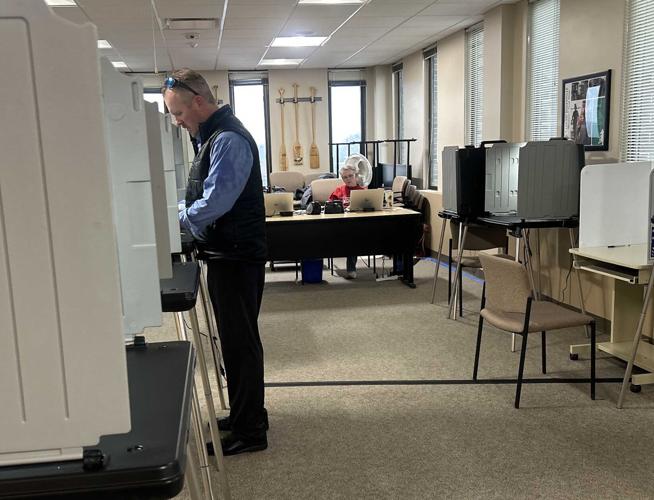
A Janesville voter casts an early ballot Thursday, April 2, 2026.
KYLIE BALK-YAATENEN/KYLIE.BALKYAATENEN@APG-SW.COM
Paul Williams, one of two incumbents, acknowledges what’s in play a few days before election day, as many city residents have already cast in-person absentee ballots.
Williams has taken steps to — literally — put his face more out there than he’s ever considered doing in a past election.
A few weeks ago, Williams paid to put his face on three different billboard advertisements along busy commuter thoroughfares in Janesville. Incumbent Larry Squire also has bought campaign billboard space locally.
“In the past, I have done newspaper ads, and I have done radio ads. But this is the first time I’ve done billboards (for an election),� Williams said. The only time I ever was on anything like a billboard was another (prior) election, when a candidate did a billboard that was against me.�
Shane Seeman, who’s in his first-ever city council campaign, is meanwhile pounding the pavement. Seeman says he’s knocked on doors all over the city.
And he says practically every voter has had one major issue in mind — the data center.
“The data center is coming up quite a bit,� Seeman said, adding that “some of that accessibility piece — housing and property taxes — has also been up there as issues that voters have shared with me.�
A crowded race
In the crowded race, candidates have sought to differentiate themselves on a deeply polarizing local issue — the proposed data center — that’s put the city on the map as a statewide spring election to watch.
In some circles, Tuesday’s results will be viewed as a referendum on city transparency on data centers and opposition in general to such projects that many people on Janesville’s southside, and others across the state where data centers have been proposed, say are good for neither the environment, utility ratepayers nor their communities in general.
On the other side of the debate, those in favor of considering siting data centers in their communities point to the positive impact of a rising property values on a chosen site, especially a brownfield site like is being considered for a data center on Janesville’s southside.
In Janesville, deep discontent with the city among southside residents over the data center has the potential to flip the council to a ‘no data center’ majority — and subsequently drive the post-election trajectory of discussions about whether or not to put one on the 250-acre southside former General Motors assembly plant site.
Current council members Heather Miller and Josh Erdman are southsiders, as are candidates Cassandra Pope and Reese Wood. Were all four to be seated, that would give the southside a 4-vote majority on the 7-member council.
Who’s on the ballot?
Williams, Seeman and Squire are on the ballot alongside challengers Ben Dobson, Pope, Reese Wood and Robert Hanson
Williams acknowledges that the data center debate has driven the crowded contest. It’s also fueled a likely referendum on next November’s ballot, on whether large projects on the GM site, like a data center, should be put to a public vote, rather the city council having the final say on them.
A November 2026 referendum appears to be ahead after more than 4,000 city residents signed a direct legislation petition last fall seeking an ordinance change to require a public referendum vote for future large projects on the GM property.
Williams says it’s shortsighted and not good for the city to seek a council seat based on a single issue like a data center.
He points out that city council members, once elected, are responsible for more than any one city issue — regardless of any one issue’s scope or size.
“We have some candidates who seem like they’re coming at it from the avenue of just the data center, the data center, and that’s it,� Williams said.
“It’s a big project, the biggest the city’s seen. But when it comes to a final decision on whether a data center fits, you’ll still be on the council afterward. You have the rest of your term to serve the community, so you do need to be prepared to focus on other things,� Williams said.
How issue intertwine
Seeman said he’s tried in his campaign to look at how issues voters bring up intertwine, rather than focusing on them in isolation.
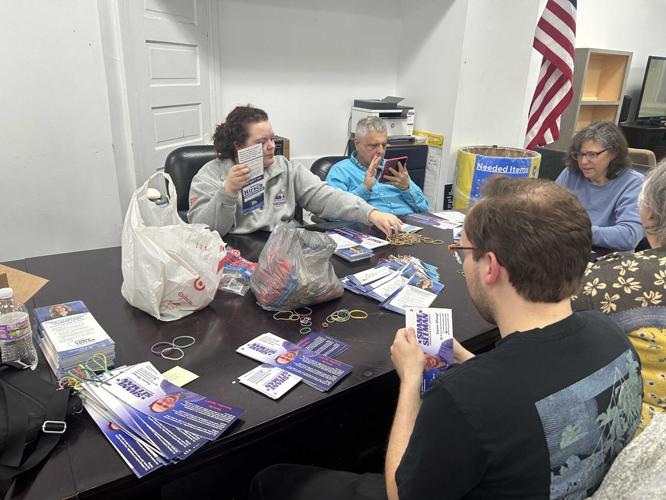
City council candidate Shane Seeman prepares literature to hand out Thursday, April 2, 2026.Â
KYLIE BALK-YAATENEN/KYLIE.BALKYAATENEN@APG-SW.COM
For instance, Seeman says he’s looked at zoning and how it ties to data centers and other land use. And he’s looked at how city tax incentives might help neighborhoods on the east and southsides strengthen their commercial and residential identities.
“All of these things together can help Janesville succeed and exceed,� he said.
Seeman’s campaign approach has included social media, yard signs, pamphlets, mailers, forums and questionnaires and door knocking.
“I’ve not seen one piece of literature from any other candidate who’s going door to door,� he said, adding that “As far as doing extra work, to me, this is just what you do. It’s not something where I’m scrambling because somebody’s doing this or that; this is just the process.�
He said in the last few days on the trail, he’s focused on making sure voters know their polling place and how to get there.
Seeman says in the final push before Tuesday, he plans to hand voters pamphlets that boil down the biggest local issues and where he stands on them. He’s got a huge stack of them.
Seeman said he’s also run into another common thread: a share of voters who tell him they feel unheard and disenfranchised.
“A lot of folks do feel left behind or not heard, or they don’t have a reason to pay attention,� he said. “So that’s kind of why I’m doing it in the way I’m doing it being out there talking directly with folks and laying out the issues at hand.�
SNOW Janesville
SNOW Janesville, a south side neighborhood advocacy group, has galvanized around the data center debate. The group has acted as a platform for opponents and skeptics of a GM site data center, hosting forums, organizing a ride-to-the-polls service, and most recently, dabbling in public polls.
This week, SNOW conducted a social media poll organizers acknowledged was unscientific but had questions crafted similarly to questions in other recent surveys circulated by the city and Forward Janesville.
SNOW organizer Cathy Erdman, a southsider who is spouse to Janesville City Council member Josh Erdman, said SNOW’s survey was intended as a snapshot of how residents — mostly southsiders who are SNOW’s main social media followers — feel about the city.
SNOW’s initial results, citing about 175 people, showed just 14% are satisfied with the city’s current track.
“That might be just as important on this election day as anything else,� Erdman said.
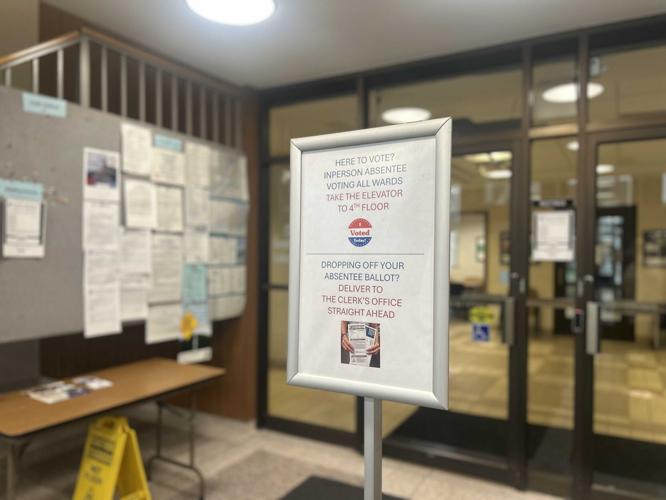
Early voting continues through Friday, April 2, 2026, in Janesville.Â
KYLIE BALK-YAATENEN/KYLIE.BALKYAATENEN@APG-SW.COM
The Forward Janesville survey released last week, of 300 likely city voters and conducted by a third party polling company — showed 51% of residents approve of the direction the city is going.
Some observers on social media also dismissed the SNOW Janesville survey as biased, because it didn’t prohibit people from filling it out more than once or guaranteeing they’re a city resident. But Erdman said it shows that some of the 17,000 people who live on the city’s south side are far less thrilled with the city’s direction than other residents.
Voter turnout
Janesville City Clerk Lori Stottler said early in-person voting is a little down so far this year, but she expected an uptick in in-person early voting on Friday, saying it would be “pretty busy.�
Stottler said on Thursday there were about 4,700 absentee ballots still out and just under 2,900 had been returned. As of Wednesday, she said about 800 people had voted early.
Where are the voters?
The city of has long been viewed by its residents as being split into three distinct geographical sectors.
Historical boundaries have generally defined Janesville’s southside as being city voting wards 7-13, south of the Rock River where it curves east and west, and south of the city’s fourth ward. The westside is generally defined as being city voting wards 1-6, west of the Rock River. The eastside is generally considered to encompass city voting wards 14-37, including most areas east of the Rock River.
Based on those geographical divisions and 2024 and 2025 voter data provided by the Rock County Clerk’s Office, 1,878 westside voters cast ballots in the 2024 spring election, and 4,656 voted on the westside in 2025.
On the southside, 1,516 voters cast a local ballot in the spring of 2024 and 3,338 southsiders voted in the spring of 2025. And on the eastside, 6,628 people voted in the 2024 spring election, while 14,572 voted in 2025.
Estimates in each of the three sectors were higher in 2025, a year when state supreme court and the state superintendent of schools races were on the ballot.
Across the city, there are currently 37,314 registered voters. Stottler estimates a 33% total turnout, or about 12,350 total voters heading to the polls either early or on election day itself.
If the south and west sides saw that kind of turnout, that would amount to between 3,000 and 3,500 voters in those two parts of the city, or about a quarter of the total predicted city turnout.
However, local elections can be subject to “dramatic swings,� Stottler said.
“The forecast can impact turnouts,� Stottler said.
“I’m not going to say whether this ballot has a lot of interest or important context or drama. There are important offices. There are hardcore voters that understand how important the offices are,� Stottler said.
“In my poll worker training I’m continuing to emphasize the importance of local elections because these are the people elected to represent democracy to make decisions for taxes and policy decisions,� she added.