
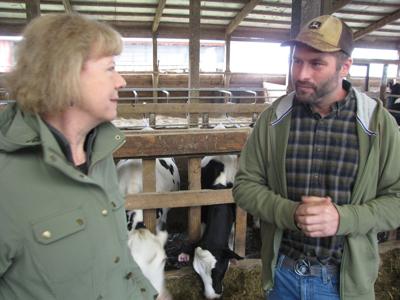
CHIPPEWA FALLS ��� Jeff Peck, who operates a dairy farm in the Town of Hallie, said crop yields will be down significantly this year.
���Someone could drive by and see a 10-foot-tall corn stalk, and think that it looks pretty good,��� Peck said Thursday. ���But the cob is undersized. It���s really frustrating, because the first part of the year was really good.���
Farmers across the Chippewa Valley are struggling with lack of moisture in their fields, Peck said.
���The (crops on a field) that have more sand is really burning up,��� Peck said.
Peck plants about 500 acres of corn, with about 150 acres going to animal feed. The cobs are smaller, and the kernels are still coming in, but there isn���t a lot of moisture in the ground.
���The quality and quantity is just going to be a lot less,��� Peck said.
Farmers who use their corn for silage are already harvesting it before the kernels get too dry, he added.
���A lot of people thought it had another month to go,��� Peck said.
Peck has done three alfalfa cuts this year. Ideally, the hay would be cut every 28 or so days. However, he���s overdue for another cut, and he isn���t sure it���s worth it to spend the time and money to cut a dry field that won���t net a good alfalfa crop. He said feeding cows low-quality alfalfa can lead to a cow producing two fewer gallons of milk every day.
���A lot of people are deciding to do an emergency chop,��� Peck said.
Jerry Clark, a UW Extension agriculture agent in Chippewa, Dunn and Eau Claire counties, agreed with Peck that yields are going to be down sharply this year because of drought conditions.
���About 50% of the subsoil moisture is below normal,��� Clark said. ���It���s at a critical stage. It���s too late for some of those fields ��� it���s been too long for them without any moisture.���
Some farms with heavier and wetter soil types are doing okay, he added.
���It���s been really hard on the lighter soil types,��� Clark said. ���They are starting to show the stress from this lack of moisture. Some (fields) might not respond to any moisture we might get. We���re using one-third of an inch a day, and we���re not getting that. We���d like to see those corn cobs fill with grain, but that���s not going to happen.���
Clark added: ���It���s going to be down a third, because the cob is a third (in size) of what it should be.���
Farmers are only getting about $4 per bushel for corn, adding that is below break-even point. The soybean market is more promising, at about $12 per bushel. However, corn yields nationwide won���t substantially be different this year, Clark said.
���The corn belt through Iowa, Illinois, Indiana ��� they have gotten their precipitation, so supply won���t be down much,��� Clark said.