
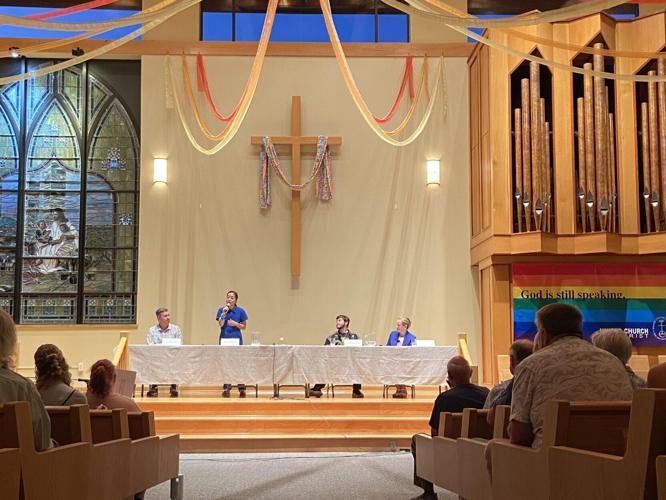
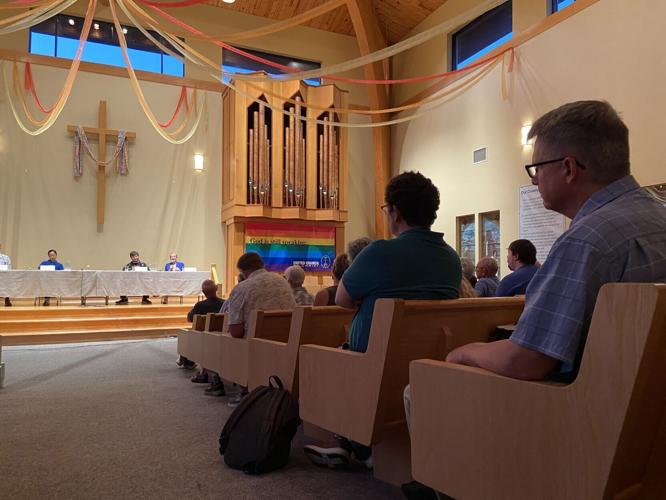

WATERTOWN — Residents packed First Congregational United Church of Christ Sunday evening to listen to four gubernatorial candidates pitch their campaigns.
Before answering questions about public education, healthcare and data centers, Democrats Joel Brennan, Francesca Hong and Kelda Roys, and Republican Andrew Manske spoke with voters sitting in the church pews.
After the two-hour event, candidates and community members mingled with refreshments catered by Chandler House Bakery.
All candidates were invited to the forum. Independent candidate David King, running as a registered write-in, accepted the invitation but did not attend the event. David Crowley (D) and Tom Tiffany (R) did not accept the invitation to the forum.
Limits on data center projects
“I am the author of a bill that (puts) a one-year moratorium on the construction of new AI data centers,” Hong said. “I support this moratorium because it is one of the most fiscally, environmentally, and honestly morally responsible things to do in ensuring that we have the regulations in place. The pause is there so that we are able to have better community control because of the scale and speed in which these data center proposals are happening. We’re not going to get the best deal if we don’t have the resources and regulations in place. We have to make sure that these large-tech companies and developers know that our natural resources are not for sale.”
“I do think that there is a requirement for regulation of data centers,” Brennan said. “I think it’s one of the biggest things that the governor and the legislature have failed on: not doing anything related to data centers over the last two years. I would propose that we stop any additional data center construction, but I would only do it for the first 100 days...(My biggest concern is) what this means for our future. AI is going to be one of the big disruptors of our lives. We are going to have peaks and valleys. We need to make sure that the peaks don’t just go to one part of the sector, and that the valleys aren’t going to be absorbed by our youngest people and the people who are going to be displaced.”
“I’m the candidate that has put forth the strongest plan for how to immediately stop the unregulated development of data centers,” Roys said. “I’m also the candidate that has committed to using executive power right away, not just for new data centers, but for the ones already under construction. We have environmental laws on the books that are just not being enforced...We have a Public Service Commission that has made some baby steps towards things like differential rates. We need to make sure that they are continuing so that we’re not subsidizing data centers.”
“I want to see what I call citizen mirror policy,” Manske said. “What that looks like is if they take out the water, it goes back in the same amount at the same temperature. If they’re going to use electricity, they have to provide their own and they build their own. But they can’t be using the public’s energy. I want that to be for the citizens. I think that’s a fair thing to ask. I think the jobs can be under contract. They need to be under contract so they’re with Wisconsin citizens. We’re not wanting foreign workers to come on in here. We’re not wanting people from California to come on in here.”
Public school funding
“The idea that a school isn’t economically viable is a crazy concept,” Roys said. “How could anything be more economically viable?...I will not sign a budget that doesn’t do right by the youngest Wisconsinites. The state needs to meet its full two-thirds funding commitment to public education. Not just for our kids, but to take the pressure off of property taxpayers and to end this horrible, divisive cycle of referendums that pits neighbors against one another and puts communities and school districts in a terrible and irresponsible budgeting position. It’s not fair. I am also the candidate that has a plan to finally bring the private voucher scheme to an end.”
“The reality of the situation is, we can fund our schools, but when there’s another shortfall, we’ll need to fund our schools (again),” Manske said. “When there’s another shortfall, we need to fund our schools. We need to attract young nurses. We need to attract young people across the country. If Wisconsin is the cheapest place, people will come here.”
“Public education is my number one issue,” Hong said. “This legislature is being sued right now because we have not met our two-thirds obligation to fund our public schools. It is in our constitution to meet not only our moral public (duty), but to ensure that every child across our state has access to a sound, basic grade public education...My plan is to ensure that we are moving to 90% special education reimbursement and that we are ending the voucher program. But the first thing we have to do is build that transparency. There is a law that we can pass to make sure that property taxpayers know how their taxes are going to schools that may not be in their community, that is a voucher school.”
“The challenge we have on this issue was driven home on election day this spring,” Brennan said. “72 school districts went to referendum this spring, 60 of them for operations. It wasn’t to build a new middle school or new science classrooms, but to keep the lights on in schools. What we have in community after community, we are pitting property taxpayers against kids, and that isn’t good enough for us...Every kid has a value, regardless of where you live, regardless of your zip code. Put on additional resources for special needs, for English language learners, for urban poverty, for rural poverty, for transportation, for differences in cost of living in places across the state, and get kids and teachers what they need in their communities. That’s what our kids deserve.”
Flock Safety surveillance technology”I don’t like them,” Manske said. “I’m not interested in becoming communist China. I’m not interested in becoming a prison-police state...There’s a lot of issues out there. Flock to me is essentially another way of mass surveillance with the populace. I think civil liberties need to be protected. I’m not interested in this cost for the citizen, just for the state.”
”We have to prohibit them from being built on any state government-owned buildings,” Hong said. “We (cannot) allow local governments to be able to reject any open records reports. I think ORR laws are actually very important when it comes to Flock cameras and being able to access that information...We’re seeing communities all across the state work with groups like (American Civil Liberties Union) to make their voices heard in preventing their law enforcement agencies from having flock cameras or using that data.”
”We all know that there is a balance between public safety and civil rights,” Brennan said. “When we lose that balance, we become less humane than we should be. Some of what we have seen in the abuse of Flock cameras is a demonstration of that from law enforcement. I think we need to be highly regulated and need to be very careful...On the broader basis, there are other states — I think California and Colorado — that have passed a privacy bill of rights that we should explore in Wisconsin.”
”We have seen an unbelievable resemblance to ‘1984’ in this country, and not just under the Trump regime,” Roys said. “We have seen our personal-private data, whether it’s private corporations that are profiting from it, whether it is social media companies that are measuring what our children are doing online and monetizing that, or whether it is our own government weaponizing that data — Medicaid data gone to ICE to rip families apart, prosecutors in anti-abortion states going to pro-choice states trying to get Flock and camera information to track patients who sought abortion here outside the borders of their state — this is real. This is what is happening in the United States. I’m a hard, Hell no, on Flock cameras.”
Healthcare policy
“Healthcare is a human right,” Hong said. “It shouldn’t be tied to your employment. It shouldn’t depend on where you’re living. I think that here in Wisconsin, like the rest of the country, we are in a healthcare crisis. Much of the reason healthcare costs are high is because healthcare prices are high. In addition to supporting a public option, as well as expanding the state insurance program and investing in an expansion of BadgerCare, we have to make sure that we’re actually taking on some of the largest corporate hospitals, keeping prices in mind, making sure that they can’t charge more. Indiana just passed legislation that’s very similar to this — by the way, that’s a red state — where you make sure that some of these prices are marketplace.”
“800 billion dollars is being taken out of Medicaid in the next decade,” Brennan said. “6 million people are being kicked off of SNAP and FoodShare in the next year, including a million kids. This is the cynical stuff that we are seeing from the federal government. But here in Wisconsin there are 72 counties. In 27 of those counties you can’t find a practicing OB-GYN. You have women going for basic healthcare hours at a time. You’re going to your prenatal visits to deliver a child for your well baby care. This is what the Wisconsin is that we live in now, and that’s not tolerable for us. That’s not good enough for us...We need 3,000 nurses a year over the next decade. There need to be clinicians and technicians. We are not getting younger as a state. We’re going to need more of that pipeline, and then finally, to make sure that mental health for us becomes part of basic health in Wisconsin.”
“My plan — terrible name, great policy — KeldaCare, will open up the very same health insurance coverage that I get as a state senator,” Roys said. “I am a state employee and I will open up the state employee health plan to let anybody buy in. It will be a public option for individuals and families, but it will also allow employers to buy into the pool. Think about making our manufacturing companies more competitive. Think about helping small business or farmers be able to finally afford healthcare for their employees. Think about lowering the costs for school districts in their insurance. Think about keeping rural hospital and clinic doors open because, unlike Medicaid which pays a substandard reimbursement, the state plan actually pays what it’s worth. We can have lower premiums and better coverage for all of us, and get closer, and faster, to universal health care with KeldaCare.”
“The idea is basically a citizen-run plan,” Manske said. “It’s easy to opt into and easy to access. I don’t want to have barriers to entry. The idea would be $100 a month. It’s not meant to replace primary healthcare. It’s meant to basically be a fallback. Think of umbrella insurance. Think about a broader citizen-wide, statewide network. The idea would be if you don’t have a primary insurance, this would basically be your own insurance. It still would cover about 30% which could still help a lot of families along the way. We’re talking about $100. We’re opening it up to young people first, who often don’t really have health care and would love to have $100 health care. Or would love to have health care at all and whose jobs may not offer it. And then increasing over time to higher ages.”
Housing developments, housing insecurity
“We absolutely need to remove a lot of the state preemption that makes it harder to build,” Hong said. “We have to make sure that we’re investing in local government by increasing shared revenue and actually having an equitable funding formula, so that local governments get their fair share. This is incredibly important too, because not only then can we tackle affordable housing issues — building more housing — but many programs important to the community are funded locally at the city or county level...For housing overall, we (must) treat this like the crisis that it is. Looking at both innovation and equity, and making it easier to build, but also making sure that we’re investing in everything from community land trusts to pilots for social housing.”
“Renters deserve safe, affordable housing that is habitable, and the right to challenge landlords when (they make) things untenable,” Roys said. “We can also reform our state zoning laws. This is really, really important if we’re going to create more affordable housing that people can use: co-ops, condominiums, co-housing and cottage courts. The state can make it more affordable for developers to do that. We can use our tax credits more efficiently to keep housing that is currently affordable, versus more expensive buying down the cost of new housing. For folks who are long-term, permanently unsheltered, the absolute best model is of course, a housing first one: putting them in permanent supportive housing. That just takes money and the political commitment to get it done. I am the candidate who will not just talk about it, but actually get it done.”
“One of the big things that we can do is make sure that the partnership between state and local government works better than it has over the last two decades,” Brennan said. “That means that shared revenue, which is really delightful to communities like Watertown and others around the state, (ensures) that the state is meeting its obligations there, not forcing communities to go to referendum. There are communities around Wisconsin that have gone to referendum for firefighters. The state is not meeting its basic needs. If we ensure the partnership between state and local government functions as it should, they will be better able to handle some issues at the local level. But we’re still going to need resources because the federal government (won’t) be our partner for the foreseeable future.”
“I’ve actually stated that I want to invest money as a Republican,” Manske said. “I know it’s a weird concept. (I propose) a state-of-the-art medical facility, maybe on the outskirts of Madison. The idea would be that it’s a co-ed facility for individuals leaving the prison system, who just like individuals on the streets, need some sort of support mechanism. They need it there, just like individuals who are homeless in the streets. They can get an answer. They can come to that facility, get food and address the issue.”
Closing statements ”I have the most experience in state government, deep policy knowledge and I have been a progressive fighter for 25 years, standing up to bullies and billionaires again and again when it was hard,” Roys said. “I’ve taken on Governor Evers on some things like school funding and criminal justice reform, where I felt like he wasn’t doing anything. That is the kind of independent thinking and strong leadership that our voters should require. It is also something that puts me in starkest contrast to Tom Tiffany, who is nothing but a rubber stamp for Donald Trump...My plans, my policies, my background and my experience put me in the strongest position to beat Tom Tiffany. At the end of the day, we need a candidate who can hold her own against Tom Tiffany and then in January against Donald Trump.”
”This is a message to (Tom Tiffany): I suggest that you quit Congress and stop going 800 miles away,” Manske said. “Come to Wisconsin full time. If you’re going to win the Republican primary and continue on, you need to be here 100% of the time because I don’t want somebody who has two jobs. I’m doing two jobs myself, and I’m here all the time working my butt off...Quit Congress. They’re not getting anything done in two, three months. Show up in the state. Tell people what you’re about. Give them a vision. Give them policy. And the Republican Party will not like me for saying that.”
”There is no magic formula to campaigning,” Hong said. “It is really about being an active listener and making sure that when it comes to governing, you are thinking about the people closest to the struggle because they should be closest to the power. Ours is a movement where now we are so excited when there are independents with a Hong yard sign. Or when we have folks who I meet at events just like this who tell me that their grandchild told them about our campaign and they didn’t think they would ever care about politics. There is a deep apathy and disillusionment right now. We can absolutely fight back, and the Republicans have put forth one of the weakest candidates they possibly could. A pedophile protector, someone who supports a national abortion ban. This is a man who is deeply unqualified because he’s an election denier, and that makes him a traitor to this country.”
”(The governor) is for you to decide,” Brennan said. “It is your decision and your decision only. And here’s what you get with me: Somebody who over the last two decades who has been in exclusively executive positions, who has been responsible for hiring and firing, for profit and loss, and who has had to stand up to extremism. (I was) the top appointed position in Governor Evers’ cabinet during COVID, when we absolutely had to make government work, where people were going to get hurt, and some people were going to die. That’s what you get from me. You also get a level of transparency that I don’t think you’re going to find in many other candidates in Wisconsin or anywhere else around the country...I appreciate you guys listening here with us tonight. I appreciate the conversations that’ll happen moving forward and truly appreciate what this community has meant by supporting everybody in this community over the last several months.”
The primary election is Tuesday, Aug. 11 and the general election is Tuesday, Nov. 3.{/div}