

JANESVILLE
A man steals a semitrailer truck.
He gets caught, serves a prison sentence and earns parole.
Now, he’s employed driving a semi for an area company.
Rhonda Suda, who directs the state Workforce Development Board’s Southwest Region at the Rock County Job Center in Janesville, cited the recent, local hiring not as an example of irony but to highlight the effects of the tight labor pool.
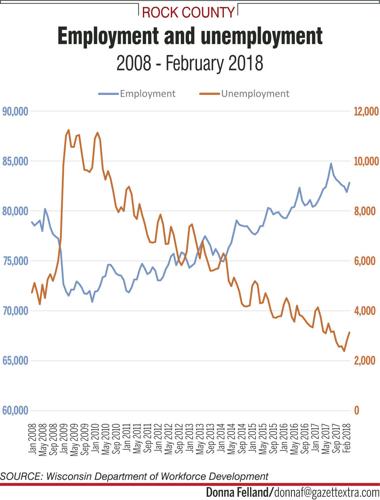
The unemployment rate in Janesville in February was 3.4 percent. That’s as low as it has been in the early months of a year in at least two decades, Suda said. Statewide, unemployment is low, about 2.9 percent, near a level that some economists would consider “full employment.�
Meanwhile, there are signs of enough hiring demand locally and regionally that even long-sidelined workers—including some with criminal records and others who have disabilities—are getting back into the labor market.
Between January and February, Rock County’s jobs market picked up 1,000 jobs, according to state Department of Workforce Development data released this week. Yet, a growing number of jobs are unfilled.
Statewide, the Job Center of Wisconsin, the state’s online jobs board, showed 95,803 job openings, Dernbach said. Within 10 miles of one of Janesville’s main ZIP codes, the board lists more than 750 job openings.
BJ Dernbach, state Department of Workforce Development assistant deputy secretary, said state-run employment offices are working to pry more people loose from the sidelines faster and get more young workers trained and ready for local jobs that need to be filled.
“We’re trying to get people off the sidelines. It’s not getting the workforce development ready for tomorrow. We’re trying to find a labor pool right now,� Dernbach said. “Employers are coming in and saying, ‘Hey, I could hire 50 people today, if we could just find the bodies.’�
As of last month, there were 82,823 people working in Rock County, an increase of about 1,860 compared to the same period last year. About 350 more people were seeking jobs in February than the month prior.
It’s hard to know if the recent uptick in jobseekers was tied to people whose part-time, holiday jobs ended in late 2017, or if it’s a sign more people who were out of the workforce long-term have returned to the job hunt.
Dernbach said the Wisconsin labor participation rate—the portion of working-age people who are employed or are actively seeking a job—has risen to 68.6 percent, the fifth-best for all states.
Suda said she has had estimates that in parts of Rock County labor participation could be higher than the state average. Some indications, she said, show it as high as 80 percent. That’s a good sign for the local economy, but it’s also a sign the group of people not seeking a job is small and getting smaller.
To add workers to the labor pool, Dernbach said, the state is focusing on the so-called “barriered population,� which includes people who have served prison time and people who have disabilities.
Dernbach said the state is more aggressively running programs that partner with companies to employ prison inmates or those just released from prison. One such program works with minimum-security inmates.
State employment offices such as the Janesville Job Center also are using state and federal funding to help people with disabilities land the jobs they want.
The funding pays for career counseling and devices that help them work. Dernbach said such clients have included a person who wanted to be a veterinary technician but needed a special chair to be able to move around and work.
The state also is helping cultivate more local apprenticeship programs that help high school students learn trade and industry skills.
Suda pointed to a partnership in Milton and Edgerton that funnels high school students into industrial “pre-apprenticeships� that include machine operating. That can prepare students in their junior or senior years to enter paid apprenticeship programs the state’s fostering.
“We’re talking average wages of $9 to $10 an hour for high school kids, and it’s on school time,� Dernbach said. “They get paid, they’re graduating from high school, and they’re coming out with a credential. The idea, though, is we’ve got to keep them in Wisconsin.�
Those measures are being combined with a new initiative to market Wisconsin as a hot spot for young people.
The marketing effort, part of $6 million workforce development bill that Dernbach said Gov. Scott Walker is expected to sign soon, would focus on wooing young workers to move from the Chicago area to Wisconsin.
Suda said at least one local light industry is offering hiring and retention bonuses of as much as $1,000. Others are becoming more amenable to parents working from home.
Some others are taking measures to entice more workers to second and third shifts. At least one Janesville industry is offering wage premiums up to $3 an hour for some late shifts, Suda said.
“That translates to $6,000 more a year. It’s huge. It’s a huge incentive,� she said.
Suda said outside the state’s own steps to boost labor participation, there’s a growing awareness among local companies that they might need to compete harder to get workers.
“They’re looking at benefits and wages. If somebody has worked five years at some place making a given wage and earning a given level of vacation, why would they come to work for me? What can I offer them to make them leave there and come to me?� Suda said.
“That’s where it’s going. A very aggressive competition.�


